
Is the Job Market Actually That Bad or Is It Just Me?
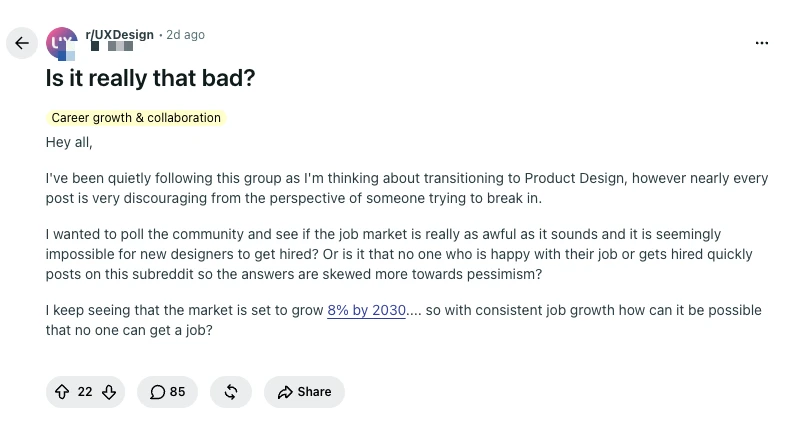
Last week I went looking for the exact question I get asked more than any other, and I didn’t have to look far. Not even 2 days apart, two different subreddits, the same question wearing two different outfits.
A few subreddits over, in one built almost entirely out of hiring nightmares, someone had already stopped asking politely.
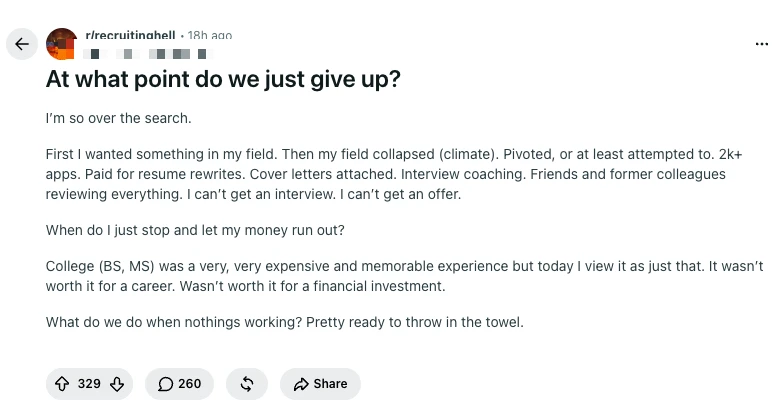
If you sent me an email right now that said “is the job market actually that bad or is it just me,” I’d tell you to stop asking the question like those are two separate things. The market is that bad. And it’s probably not just you. Those two truths coexist, and pretending the second one isn’t affected by the first one is the fastest way to drive yourself insane.
I recognize both of those posts because I’ve written versions of them myself. Eight years as a recruiter, then a dead-end year of my own applications, means I’ve sat on both sides of the exact process everyone in those threads is describing, and neither seat is the safe one anymore.
So let’s actually look at what’s happening, because “it’s not you” isn’t worth much without the receipts.
The numbers that explain why you feel crazy
In 2024, I sent 241 applications during that search and heard back from 85 of them. Twelve turned into interviews. One became a job offer: Sortly. A 5% interview rate is what my recruiting background got me. If the math doesn’t work out with that much insider knowledge, it isn’t about you.
Start with the applicant math: the typical job opening now pulls 242 applications, nearly five times the roughly 50 it drew in 2021, according to Business Insider’s analysis of Novorésumé data. That’s a different game than the one you might remember playing a few years ago, not a slow month.
A quarter of those listings are ghost jobs: posted to placate a nervous exec, or to keep a resume pipeline warm for a role nobody’s actually filling. Layer in AI screening, which 65% of employers now use to reject candidates before a human opens the file, and you get a process where doing everything right still isn’t enough to win. I broke down the actual mechanics, the Boolean searches, the 24-hour application window, the tools that got me through both, in a separate guide. That one’s about tactics. This one is about the question underneath them: am I the only one this is happening to?
A quarter of those listings are ghost jobs: posted to placate a nervous exec, or to keep a resume pipeline warm for a role nobody’s actually filling.
You’re not, and here’s a number that proves it without touching your inbox at all. The Bureau of Labor Statistics tracks something called the quits rate: the share of workers who voluntarily leave a job in a given month. It peaked at 3.0% in November 2021, the height of the Great Resignation, when people felt confident enough to walk away from a job before they had the next one lined up. By the BLS’s May 2026 report, it had fallen to 1.9%, about a third below that peak, stuck there for a second straight month. People who have jobs are holding onto them with both hands. That shrinks the real opening pool even further, because fewer people leaving means fewer backfills to post. The market looks bigger on a job board than it actually is.
The white-collar recession nobody wants to name
Here’s the part the unemployment headlines miss. The overall economy might be fine on paper, but the pain concentrates in the exact roles this blog’s readers hold: designers, engineers, product managers, recruiters, writers. Tech has shed hundreds of thousands of jobs since 2023. By spring 2026, Meta had cut 8,000 roles. Microsoft followed with 5,000 more that July. Professional services, finance, and marketing have tracked the same pattern.
The term floating around is “white-collar recession.” It’s not an official economic designation and an economist would probably tell you it’s imprecise. But the pattern is real. Blue-collar hiring hasn’t stopped. Service sector hiring hasn’t stopped. The cuts are concentrated in knowledge work, the roles that used to feel safest. Layoffs in 2022 and 2023 were framed as pandemic over-hiring corrections. Three years later, with Meta and Microsoft still cutting in 2026, that explanation doesn’t hold anymore.
What’s different this time is who’s getting cut. These aren’t layoffs concentrated in recruiting teams or volatile divisions. Product managers, UX researchers, senior engineers, people with a decade of performance reviews that say “exceeds expectations.” People who did everything right and still got a calendar invite titled “organizational update” on a Tuesday morning.
The downstream effect on the current job market is that you’re competing against these people now. Every job posting has someone with 10 years of experience applying alongside someone with 3. The AI screening tool doesn’t prefer the person who’s a better fit for the role. It prefers the person whose resume matches more keywords from the job description. People with longer careers have more keywords. You do the math.
The AI screening tool doesn’t prefer the person who’s a better fit for the role. It prefers the person whose resume matches more keywords from the job description.
If you’re an entry-level or junior designer, it’s even worse. I broke down what’s happening to entry-level design roles in a separate post, and the short version is: companies stopped training people. They want someone who can ship on day one. They post junior titles with senior requirements, ask for 3 to 5 years of experience and a portfolio that looks like someone who’s been doing the job for a decade.
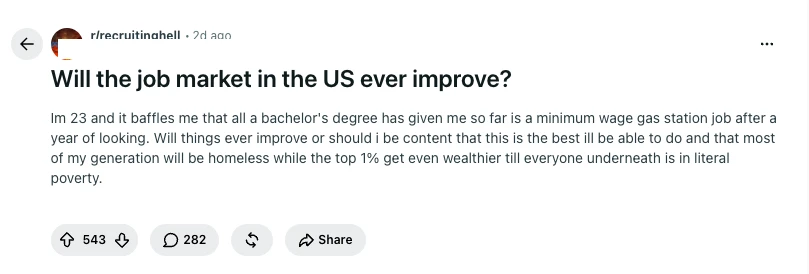
That post has 543 upvotes and 282 comments from people nodding along. It’s not a referendum on any one of them, including you.
Why your brain is lying to you right now
Knowing the market is broken doesn’t stop your brain from concluding that you’re the problem. It should. Knowing something intellectually and feeling it emotionally are two different biological systems running on different wiring.
Social rejection activates the same brain regions as physical pain. The part of your brain that lights up when you stub your toe also lights up when someone ghosted you after three interview rounds. Every non-response, every “we’ve decided to move forward with other candidates,” every application that disappeared into an ATS black hole. Your brain processes each one as a micro-injury. Two hundred applications with 190 rejections or ghosts is not 190 disappointments. It’s 190 small pain events your brain is absorbing in a condensed timeframe.
After enough of them, something shifts. You stop opening Reddit threads looking for reassurance. You sleep at weird hours. You stop customizing cover letters, not because you’re lazy, but because your brain has started to learn that your behavior doesn’t affect the outcome. Martin Seligman called this learned helplessness, and it’s a predictable biological response to uncontrollable stress. Sending 100 applications and hearing back from 5 of them teaches your brain the same thing his lab dogs learned when they stopped trying to escape an inescapable situation: effort doesn’t matter.
You stop opening Reddit threads looking for reassurance. You sleep at weird hours. You stop customizing cover letters, not because you’re lazy, but because your brain has started to learn that your behavior doesn’t affect the outcome.
The question “is it the market or is it me” is itself a symptom of this state. Your brain is searching for a reason that puts you back in control, because if the problem is you, then you can fix it. If the problem is the market, you can’t. That’s terrifying. So your brain defaults to blaming you. Your brain would rather believe you’re inadequate than believe you’re powerless. Inadequate can be fixed. Powerlessness cannot.
I wrote about this in more depth in my post on job search burnout, but the short version is: the people who get through this aren’t the most optimistic. They’re the ones who separate their self-worth from their inbox. They cap applications at two hours a day so they don’t slide into a learned helplessness loop. They treat each interview as a practice rep, not a verdict on their value as a human. They build their identity around something other than their employment status.
Nobody posts when it goes fine
Go back to the first screenshot at the top of this post. The poster asking “is it really that bad” used the term survivorship bias to explain the subreddit’s mood. Close, but that’s not quite the mechanism. Survivorship bias is when the losers vanish from the sample, so all you see are the ones who made it. What’s happening in a job-search subreddit runs the opposite direction. The people who are doing fine didn’t disappear. They just never showed up.
Think about the last stretch where your job search was actually going fine. Did you write a post about it? Probably not. “Applied Tuesday, heard back the next week, had a good call with the hiring manager” isn’t a story. It doesn’t ask anything of the reader. The post about ending up at a gas station after a year of searching, the one that pulled 543 upvotes and 282 comments earlier in this piece, is a story. Silence and rejection are stories. Getting hired quietly is just Tuesday.
That’s negativity bias. It’s one of the most replicated findings in psychology: bad experiences get remembered longer, felt harder, and talked about more than good ones. Psychologist Roy Baumeister and his colleagues put a name to it in a widely cited 2001 paper, “Bad Is Stronger Than Good.” Social platforms didn’t invent that wiring. They amplify it. A complaint gets replies. A vent gets upvotes. A calm “things are going fine, actually” post gets scrolled past, because there’s no friction in it, nothing to argue with or commiserate over. The people who are fine went back to their lives and didn’t feel the need to announce it.
The people who are fine went back to their lives and didn’t feel the need to announce it.
Ranting about it doesn’t make you dishonest, or dramatic, or a bad sport. The gas station post is real, the 2,000-application post is real, and so is the exhaustion behind both of them. The sample is what’s skewed, not the stories in it. Complaints get written down. Good outcomes just happen, quietly, to someone who’s already closed the tab.
So when a subreddit reads like universal collapse, trust what you’re feeling. Just don’t trust the sample size. You’re looking at the loudest slice of the market. The quiet part never had a reason to post.
What my own most recent search looked like
I left recruiting years ago, but the habit of tracking every number never left. Two years after that 241-application search landed me at Sortly, I ran the exact playbook from my guide on applying in a tough market again, this time trying to get out. Between April and June 2026, same Boolean searches, same 24-hour application window, aimed squarely at Product Designer and Senior Product Designer roles. Here’s exactly where those 85 applications went.
My application funnel, April–June 2026
1.2% became an offerFifty-one of 85 applications went straight into the ghost pile. Twenty-eight got an actual rejection. Six turned into interviews, and four of those ended in a polite no after a screen or two. One process, Spotify, moved so slowly the responses just thinned out until they stopped. The sixth thread reached a final round and turned into an offer. I took it — that’s Veeva, where I work now.
The rate is slightly better than the numbers I opened this post with (7% interview rate here, versus 5% across the larger 241-application search two years earlier), but the shape is identical: a wall of silence, a smaller pile of no’s, and a sliver of real conversations that decide everything. The market didn’t get kinder between that search and this one. I just got quicker at recognizing which threads were worth chasing and which ones to let go cold before they cost me any more attention. That doesn’t shrink the market. It just makes the waiting less brutal.
Reflective Coda
I’m not going to tell you the market will get better soon. I don’t know if it will. I’m not going to tell you to network harder or polish your portfolio or learn the one weird trick that hiring managers hate. You’ve heard all of that, and some of it works, and none of it answers the question you actually came here with.
That question is: am I the only one? Am I invisible? Did I pick the wrong career? Is there something wrong with me that everyone else can see and I can’t? No. You’re not the only one, you’re not invisible, and you didn’t pick the wrong career. What’s broken is a labor market that treats qualified people like disposable inputs and ghosts them without a second thought.
I didn’t write this to make you feel better. I wrote it to make you feel less alone. Those aren’t the same thing, and only one of them was ever within my control.
Somewhere right now, someone else is drafting a post asking if it’s really that bad, or wondering out loud if it’s time to give up. It is that bad. And it’s not just you. Across two searches, two years apart, I’ve sent 326 applications and heard nothing back from 207 of them. Hold both truths at the same time, and let yourself off the hook for the rest.
Sources
- The Average Job Opening Now Gets 242 Applications (Business Insider/Novorésumé, Feb 2026)
- Ghost Job Statistics 2026: 18-27% of Listings Are Fake (Greenhouse, ResumeBuilder, Clarify Capital, 2024-2025)
- 65% of Employers Will Use AI to Reject Candidates in 2025 (Resume Builder, Forbes, Oct 2024)
- Job Openings and Labor Turnover Survey (JOLTS) News Release (U.S. Bureau of Labor Statistics)
- Meta Lays Off 8,000 Employees as AI Casualties Mount (NYT, May 2026)
- Microsoft Lays Off Nearly 5,000 Employees (TechCrunch, Jul 2026)
- “Does Rejection Hurt? An fMRI Study of Social Exclusion” (Eisenberger, Lieberman & Williams, Science, 2003)
- “Learned Helplessness” (Martin Seligman, Annual Review of Medicine, 1972)
- “Bad Is Stronger Than Good” (Baumeister, Bratslavsky, Finkenauer & Vohs, Review of General Psychology, 2001)