
How to Network for a Job When You Hate Networking
Every recruiter I know has a graveyard of unanswered LinkedIn messages. Mine was long. Most opened with “I hope this message finds you well” and had a resume attached before the person had said a single specific thing about the role, the team, or me. I ignored almost all of them. Not because I didn’t want to help. Because there was nothing in the message I could say yes to yet.
In this post
Why most networking messages get ignored, how to write the kind that gets a reply, and why reaching outside your own field pays off more than reaching harder inside it — from the person who used to ignore them.
That’s the version of networking most job seekers dread, and the version that doesn’t work. Networking for jobs doesn’t have to mean the cringe LinkedIn cold-add or the elevator pitch at a mixer. It means becoming the message someone actually wants to answer.
Sourcing and messaging candidates was my job as a technical recruiter. I’ve sent and answered more cold outreach than I could count. So when I switched sides and started job hunting for myself, I already knew which messages worked and which ones I’d have deleted without reading past the first line. Knowing that didn’t make writing my own any easier. I still stared at the blank message box the same way everyone else does.
That’s the thing nobody says about networking for jobs: it’s not a personality trait. Extroverts don’t have some secret advantage that makes the ask less awkward for them. They just do it more, so the awkward part gets smaller each time. The skill underneath “networking” is closer to research than to charisma. You’re trying to find out something true about a role, a team, or a company, and you build a message around that specific question instead of building it around what you want from them.
Referral applications make up a small share of the total applications submitted for any given role, but they convert at a much higher rate: one analysis of over 15,000 applications found referrals were only 6% of submissions but accounted for 37% of hires.
Why most networking messages get ignored
A recruiter’s inbox is a pile of asks, and yours is one of hundreds. Every message that opened with “I hope this message finds you well” got the same treatment: skimmed for a job title, then closed. Every message with a resume attached and no context got the same treatment too. Not out of malice. There just wasn’t enough information yet to act on.
The shape that got a response, every time: tell me something specific before you ask me for anything. Something like, “I saw you’re hiring for a Product Designer role, and the JD mentions a heavy Figma variables system. I built one from scratch at my last job, happy to talk through it if that’s useful.” That’s a message I can do something with. I can forward it. I can say yes to a fifteen-minute call. I can’t do anything with “I’d love to pick your brain sometime.”
“Networking” is the word that makes this feel harder than it is. Drop the word. What you’re actually doing is asking a specific person a specific question you can’t Google. That reframe is most of the anti-cringe work right there. You’re not selling yourself at a mixer. You’re doing the same research you’d do for a UX interview, except the subject is a company instead of a user.
The message that actually gets a reply
Three sentences, in this order: what you noticed, why it’s relevant to you, and one clear, small ask. Not “let’s connect,” which isn’t an ask, it’s a gesture nobody has to answer. A small ask sounds like: “Would you be open to a 15-minute call about how the design team is structured?” A person can say yes to that in about four seconds. They can’t say yes to “let’s connect” because there’s nothing to say yes to.
Lead with the company or the work, not with yourself. A message about “my background” and “my skills” reads as a pitch. A message about their team, their product, or something specific they posted reads as genuine interest. Recruiters and hiring managers can tell the difference in the first sentence.
I made this mistake myself, early in my own search. I wrote one templated message, not even a good one, and pasted it to a handful of people with the name swapped. Nobody replied. Networking works fine. A form letter with the name swapped isn’t networking, it’s a chain email with better formatting.
It’s worth the slower path. Referral applications make up a small share of the total applications submitted for any given role, but they convert at a much higher rate: one analysis of over 15,000 applications found referrals were only 6% of submissions but accounted for 37% of hires. Referred candidates also move faster. Jobvite’s research puts the average time-to-hire for a referral at 29 days, against 55 days for someone sourced through a career site. None of that is because referred candidates are more qualified. It’s because someone already vouched for the part a resume can’t show: that you follow through, that you’re not a flight risk, that you’re someone worth another call.
| Share of applications submitted as referrals | 6% |
|---|---|
| Share of hires those applications produce | 37% |
Referrals are a sliver of the applications submitted for a role, roughly six out of every hundred, but they convert to more than a third of the hires. Source: Salarship analysis of 15,312 applications, via The Interview Guys.
| Referred candidate | 29 days |
|---|---|
| Candidate sourced via career site | 55 days |
A referred candidate gets hired in roughly half the calendar time of someone who applied cold through a careers page, nearly a full month shaved off the process. Source: Jobvite.
I already wrote the exact script for turning a conversation like this into a referral ask in my tough market job search guide. The short version: build the relationship first, let the referral offer come from them.
Network in three directions, not one
Most job seekers only network with people who already do their exact job, which is the most saturated, least useful direction to reach in. Other product designers are good for portfolio feedback and a case-study gut check. They are not seeing anything you’re not already seeing. If your whole network is people scrolling the same job boards you are, you find out about an opening at the same time everyone else in your circle does.
Moderately weak ties led to more job placements than strong ties did.
Same-field networking still earns its place. UX Meetups are still the easiest place to find people willing to take a call, and I’ve gotten more real conversations out of showing up and talking to whoever’s next to me than out of any cold LinkedIn campaign. Just don’t stop there.
Local meetups are the lowest-stakes way to meet strangers who are useful in ways you can’t predict. The room is a mix you’d never assemble on your own: people breaking into the field, veterans who’ve been doing the job for a decade, and every once in a while someone who mentions an opening before it’s posted anywhere. You don’t need a message that gets a reply because nobody’s inbox is involved. Walk up to whoever’s nearest, ask what they’re working on, and let the room do the rest. The worst case is you had a conversation with a stranger about something you both care about, which is not a bad use of an evening.
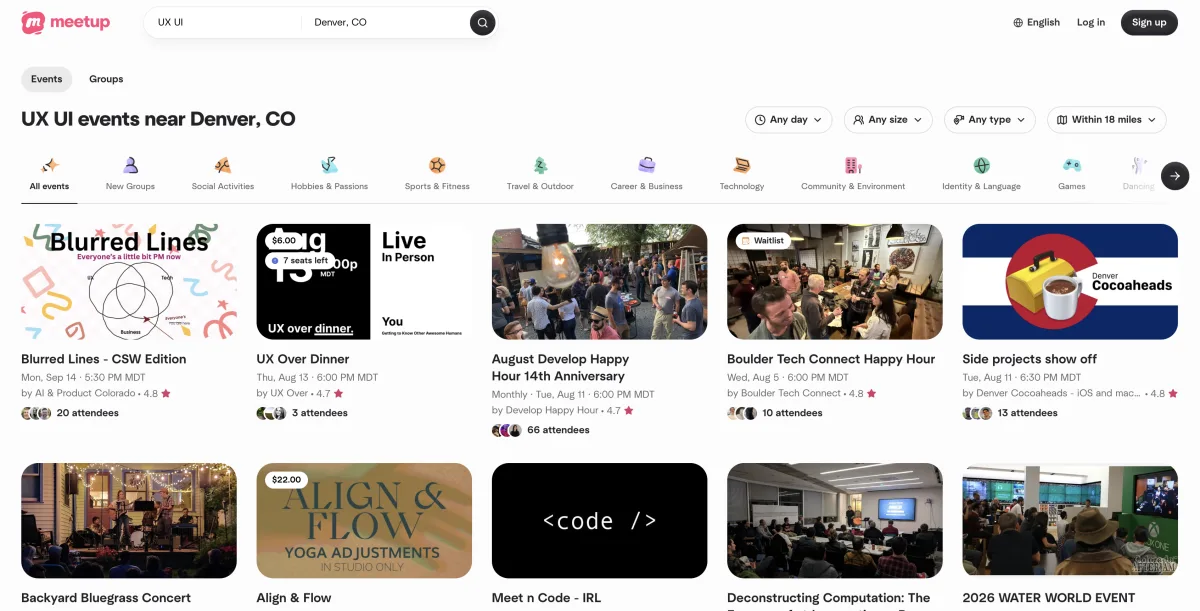
A quick Meetup search for “UX UI” turns up more low-stakes rooms to walk into than most job seekers ever check.
Adjacent fields are the second direction, and the one most job seekers skip. Product managers, researchers, and engineers sit inside hiring conversations before a role is ever posted. They hear about a headcount opening up or a team getting funded weeks before a listing exists, and they can vouch for how you actually work with a cross-functional team, which is a different kind of proof than a portfolio.
Different fields are the third direction, and the one that feels the least relevant, which is exactly why it’s the most overlooked. A five-year experiment on LinkedIn, covering 20 million users and published in Science in 2022 by researchers from MIT, Harvard, Stanford, and LinkedIn, found that moderately weak ties led to more job placements than strong ties did. The effect peaked around connections who shared roughly 10 mutual contacts with you. Past that point, the tie stopped helping, because you were both already seeing the same postings. A former coworker who left design entirely. A friend from a bootcamp cohort who pivoted into a different industry. Someone you met once at a wedding who works somewhere you’ve never applied. None of them are competing with you for the same roles, and that’s exactly why they’re the ones most likely to hand you something you’d never have found on your own.
Relative job-placement likelihood by tie strength, 20M LinkedIn users
Peak at ~10 shared connectionsPlacement likelihood rises with tie strength to a peak near 10 shared connections, then falls back as ties grow strong enough that you’re both scrolling the same postings. Recreated from the published figure in Rajkumar, Saint-Jacques, Bojinov, Brynjolfsson, and Aral, Science 2022. The inverted-U shape and the ~10-connection peak are the study’s own findings; intermediate points are approximate.
I already wrote about the deliberate version of this: building relationships in a field before you commit to a full pivot into it, using Herminia Ibarra’s research in my piece on career change at 40. This is the smaller, lower-stakes version. You’re not planning a pivot. You’re just refusing to let your network stay one field wide.
The mechanism is the same no matter which direction you’re reaching in: the informational interview. A 15-20 minute call where you ask someone about their role, their team, or their path into a company or industry, and you do not ask them for a job. That last part is what makes people willing to say yes. Nobody wants a call that’s secretly a job interview they didn’t agree to.
Ask for it directly. “Would you be open to a 15-minute call about your path into product design?” works for someone in your field. “Would you be open to a 15-minute call about how your team works with design?” works for someone adjacent. “Would you be open to a 15-minute call about how you ended up in that industry?” works for someone in a different field entirely. Pick a specific day and time window in the same message, so saying yes doesn’t require them to do any scheduling work. Show up with three questions written down. Send a one-line thank-you within a day. That’s the whole mechanic, regardless of which direction you’re reaching in.
Reflective Coda
Networking for jobs will always feel a little uncomfortable, and that’s fine. The discomfort isn’t a sign you’re doing it wrong. It’s a sign you’re asking for something instead of waiting for something to happen to you. What actually kills momentum isn’t the awkwardness. It’s treating networking like a full extra job on top of the one you’re already searching for. Two or three good conversations a week beats fifty rushed ones. If job search burnout has already flattened you, networking is usually the first thing to go, and that’s a signal to rest, not a character flaw.
Pick one person. Ask one specific question. Send it today.
I still have that graveyard of unanswered messages, half-written from the other side now, as the job seeker instead of the recruiter. The difference is I finally know what makes a message worth answering. I write the version that tells the other person something true before it asks them for anything. Most of the time, that’s enough to get a reply. A good question, sent to the right person, was the whole trick the entire time.
Sources
- Referred Candidates Get Hired 4x More Often (The Interview Guys, analysis of 15,312 applications via Salarship)
- 4 Reasons to Invest in Employee Referrals (Jobvite)
- The Power of Weak Ties in Gaining New Employment (MIT Sloan, on the 2022 Science study by Aral, Rajkumar, Saint-Jacques, Bojinov, and Brynjolfsson)