
I Scheduled Six-Round Interview Loops for a Living. Here's Why They Keep Growing.
I can’t even tell you how many great candidates I’ve watched walk away from a role I was hiring for as a former recruiter because the process was too long. I can tell you that the people who added rounds to the loop weren’t trying to make it harder for candidates. They were trying to make it easier for themselves to feel safe making a decision.
In this guide
I’ll cover what Google’s own hiring data found about interview rounds, why loops keep growing anyway, and how to tell a normal process from a broken one.
I once spent forty minutes hunting for a single hour when a candidate, a hiring manager, a director, and a fourth person nobody could quite explain the purpose of were all free at the same time. That was round five. Nobody had sat down and decided this candidate needed a fifth round. It accumulated, one stakeholder request at a time, until I was the one holding the calendar and apologizing to the candidate for how long everything was taking.
That was one requisition out of the 40-plus I managed at any given point as a technical recruiter. Multiply that scheduling problem across dozens of open reqs and an interview loop that should take three weeks stretches into three months. Candidates on the other end of that loop tend to assume more rounds means the company is being careful. Having sat on the scheduling side of that exact process for eight years, I can tell you that’s usually not what’s happening.
I’m not writing this as someone who set hiring policy. I never ran a talent org or decided how many rounds a company should require for a role. I was the person coordinating the calendars, chasing down interviewer feedback, and explaining to candidates why round four had quietly turned into round six. That’s a narrow view, and it’s also the view almost nobody writes from. Most of what’s out there about interview rounds is candidate-side advice or Reddit venting about a bad experience. Nobody’s explaining the mechanics from the side of the table where the rounds actually get added.
So why do companies have so many interview rounds when a second interview used to be enough to make a call? The honest answer has less to do with rigor and more to do with who’s afraid to own the decision. Here’s what I watched happen, backed by the industry data on why it keeps happening everywhere, not just in the reqs I ran myself.
The company most obsessed with data ran the numbers on this
Google is the company most associated with rigorous, data-driven hiring, so its own internal research on interview rounds is the strongest place to start. Todd Carlisle, then Google’s VP of People Analytics, looked at years of hiring data and found something that should reframe how anyone thinks about a long interview loop.
Four interviews predict a hiring decision with 86% confidence. Every interviewer added after that fourth one increases predictive accuracy by roughly 1%, which the data itself treats as statistically almost nothing. A panel of four interviewers reached the same hire or no-hire decision as a larger panel 95% of the time. More rounds weren’t producing meaningfully better decisions. They were producing the appearance of thoroughness while the actual signal flattened out.
More rounds weren’t producing meaningfully better decisions. They were producing the appearance of thoroughness while the actual signal flattened out.
Google acted on that finding. After standardizing on four interviews, the company cut its average time-to-hire from around six months down to 45 days. The company most invested in “getting hiring right” ran its own numbers and concluded that everything past interview four was closer to theater than diligence.
I think about that stat every time I read about a candidate doing seven or eight rounds for a mid-level role. Somewhere in that process, round five stopped being about the candidate and started being about something else entirely.
Why the rounds pile up anyway
If four rounds is where the signal plateaus, why do loops keep growing? Not because companies think they’ve found a better formula than Google’s. Reworked.co’s 2026 hiring coverage found that 39% of companies admit candidates face too many interview rounds, and 52% admit their own hiring process is too long. This isn’t candidates imagining the problem. It’s employers saying it out loud about their own process and still not fixing it.
The numbers back up what I watched happen req by req. Average time-to-hire has climbed to roughly 42 days in 2026, up from 29 to 33 days a few years earlier, and senior or specialized roles regularly run past 60 days. Companies that used to run two or three rounds now commonly run three to six or more: a recruiter screen, a hiring manager conversation, a skills assessment, a culture interview, sometimes a personality assessment, sometimes a take-home project. Other 2026 industry roundups put five to eight rounds as common practice at many companies, with roughly 15% of employers saying five-plus rounds is now their standard, not their exception. A third round interview used to mean you were close to an offer. Now it’s often just the midpoint.
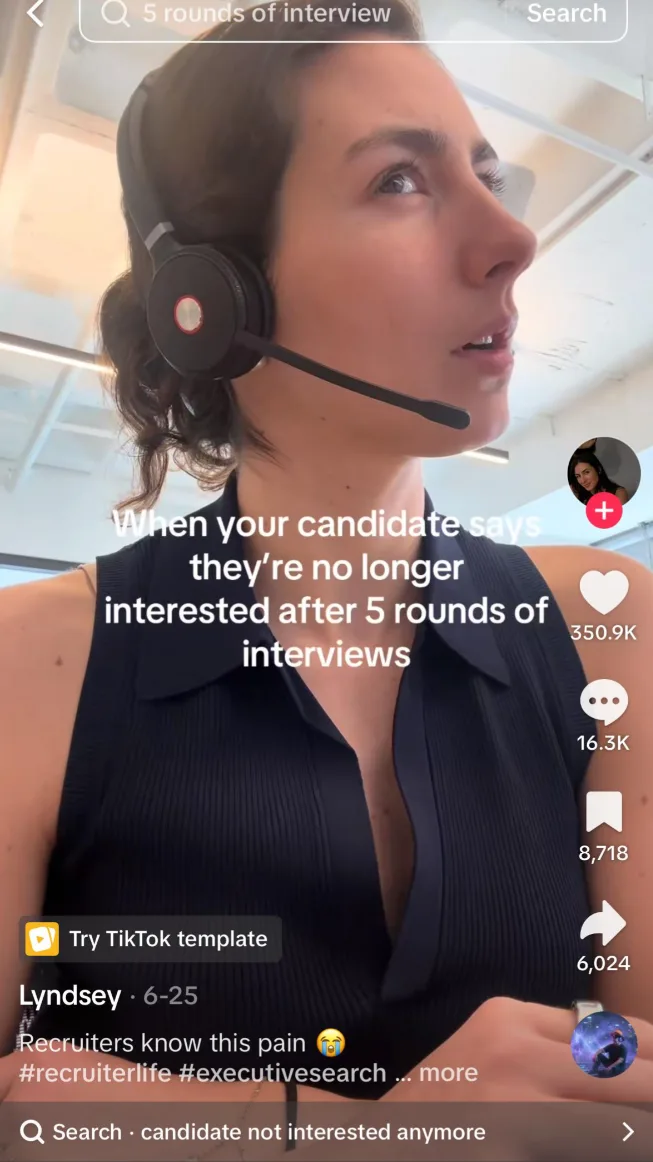
Recruiters are the ones venting about this online, not just candidates. That’s the tell that this isn’t a candidate-side perception problem.
Here’s what I actually watched drive that growth, requisition after requisition.
Risk gets spread across more people. A bad hire that six people signed off on is six people’s mistake, not one person’s. I watched hiring managers add a round not because they needed more information, but because they wanted more names attached to the decision if it went wrong later. It’s insurance dressed up as rigor.
A bad hire that six people signed off on is six people’s mistake, not one person’s.
Extra rounds are often a symptom of disagreement. When a hiring team hadn’t actually agreed on what the role needed, a new round got added mid-search almost every time. It rarely came from a deliberate plan. It came from someone on the team saying “let’s just also have them talk to X,” which is usually shorthand for “we still don’t know what we’re looking for.”
Every stakeholder wants their own thirty minutes. Once a director or a cross-functional partner asked to meet a candidate, that request became an official round. It almost never got removed for the next requisition. I watched loops grow this way constantly, not through one decision but through individually reasonable requests that nobody was responsible for saying no to.
A slow labor market removes the pressure to move fast. When there’s always another candidate willing to sit through round five, the urgency that used to force a decision disappears. Company size makes this worse. Zippia’s hiring data shows small and mid-size businesses interview roughly 9 to 11 people per hire, while enterprise companies interview 65 to 75. More candidates in the funnel means more stakeholders who each want a say, and more rounds required to get all of them in a room.
How to tell a normal loop from a broken one
Not every long process is dysfunctional, and it’s worth naming the counterexample honestly. Amazon standardized its hiring around a “loop” of four to six interviews plus one Bar Raiser: a trained interviewer from outside the immediate team who can veto the hire regardless of what the hiring manager wants. It’s a deliberately designed multi-round process, and it still caps out around four to six rounds with one person clearly responsible for the final call.
That’s the pattern worth watching for. A structured process has a defined number of rounds and someone who owns the decision. A broken one keeps adding rounds because no one owns the decision, so every new stakeholder gets their own audition instead of a briefing from someone who already talked to the candidate. By the time a candidate reaches what’s billed as a final round interview, interview fatigue has usually set in on both sides of the table, not just the candidate’s.

That tracks with what I’ve seen since moving to the other side of the table myself. I pivoted into product design, and the loops I’ve sat through as a candidate typically run three to five rounds. The first three are where the real evaluation happens: a portfolio review, a design exercise, a conversation with the hiring manager that actually probes how I think. Anything past round three has usually felt like a formality, a culture-fit conversation with someone who already knew the answer going in. That lines up with Google’s own data: the real signal is gone by round four, and everything after it is confirmation, not discovery.
Career-advice sources broadly agree on where the line sits: six-plus rounds for a non-executive role is a real red flag, usually signaling disorganization or a role the company hasn’t actually defined yet. The same six rounds for a senior or executive hire at a large company barely raises an eyebrow. The number alone doesn’t tell you which one you’re in. What tells you is whether anyone can explain, up front, what each round is for and when you’ll hear back.
That’s a fair thing to ask about directly. If a recruiter can’t tell you how many rounds to expect or who makes the final call, that’s information, not rudeness on your part for asking. I wrote more about the tactics that actually move a job search forward, including what a normal application-to-offer funnel looks like, in my guide to applying for jobs in a tough market. And if you’re already past the interview stage and stuck in the silence afterward, that’s a different problem with its own mechanics, one I covered separately in my post on job search burnout. This post is about why the rounds exist in the first place. That one is about what the waiting does to you.
Reflective Coda
If I could change one thing about how candidates read a long interview loop, it’s this: stop assuming extra rounds are a compliment. They usually aren’t. They’re more often a sign that nobody on the other side of the table has the standing to just decide, so the process keeps expanding until enough people have weighed in that the decision feels safe to make.
Ask about the loop early, and ask directly. How many rounds should I expect, and who makes the final call? A recruiter who can answer both questions clearly is describing a process someone actually designed. A recruiter who can’t is describing a process that’s still accumulating rounds the same way mine used to: one request at a time, with nobody responsible for saying that’s enough.
A process built entirely out of individually reasonable requests can still add up to something nobody would have designed on purpose.
None of this means you should walk away from every six-round process. Some of them are genuinely for senior roles at large companies where that’s just how hiring works. What it means is that you get to treat the round count as data, the same way Google eventually did with its own hiring, instead of a referendum on how seriously the company is taking the decision.
I still think about that hour I spent hunting for a shared slot on four different calendars for one candidate’s fifth round. Nobody in that process was trying to make the candidate’s life harder. Everyone involved genuinely thought their thirty minutes mattered. That’s exactly the problem. A process built entirely out of individually reasonable requests can still add up to something nobody would have designed on purpose.
Sources
- Open-Sourcing Google’s HR Secrets (Knowledge at Wharton)
- Here’s How Many Google Job Interviews It Takes to Hire a Googler (CNBC, Apr 2019)
- 17 Interviews to Get a Job? Welcome to 2026 Hiring (Reworked.co, 2026)
- 2026 Job Interview Statistics (Yomly, 2026)
- 40 Job Interview Statistics You Need to Know (RecruitBPM)
- 2026 Job Interview Statistics Roundup (Zippia)