
AI Interviewers Are Here. This Is My Experience.
Kendiana Colin was two questions into an interview for an entry-level role at StretchLab when the AI interviewing her broke. The 20-year-old Ohio State student was talking to “Alex,” an AI interview agent built by a company called Apriora, when it started repeating the phrase “Vertical bar Pilates” on a loop. It paused, seemed to recover, then repeated it again before ending the interview outright. Futurism captured the video, and it was quickly picked up by Yahoo Tech and AOL. Colin’s own reaction was simple: “I was freaked out.”
In this guide
I’ll cover how mainstream AI interviewers actually are, why companies are running them at scale, and what the glitches and lawsuits mean for your next interview.
“I guess I was supposed to earn my right to speak to a human.”
Kendiana Colin
The clip went viral for the obvious reason. It’s unsettling to watch a hiring decision get made, or fail to get made, by something that just short-circuited on camera. But the detail that should worry candidates more than the glitch itself came out in TIME’s reporting on the same story: some candidates in this exact news cycle weren’t told in advance they’d be talking to an AI at all. One was told only that she’d speak with “Alex from Apriora,” with no mention that Alex was software. Apriora has since rebranded to Alex AI, which market commentary widely read as an attempt to put distance between the company and the footage.
Then it happened to me too
My first AI interview happened in April 2026. It felt less like a conversation than a monologue with a response field attached. I went in curious on two fronts, as a former recruiter who used to sit on the other side of exactly this kind of screen, and as a product designer who’s designed AI chatbots myself. That curiosity didn’t survive first contact. The whole thing felt deeply impersonal, and I had no intention of moving on to the next round. Curiosity, it turns out, is exactly what gets the cat.
Another request for an AI interview showed up again in my inbox, the next month, this time, from a different company:
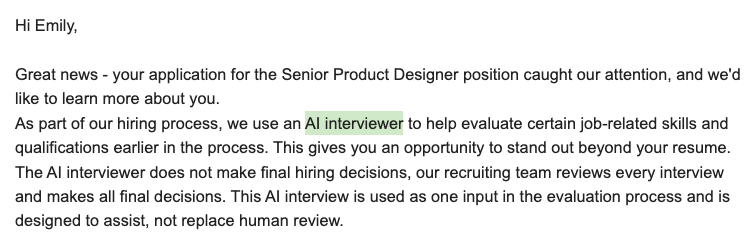
I read that paragraph the way I’d read any policy memo written to pre-empt an objection: reassuring on its face, and revealing about what the company already expected candidates to push back on. I wrote back the same day, and I didn’t hedge:
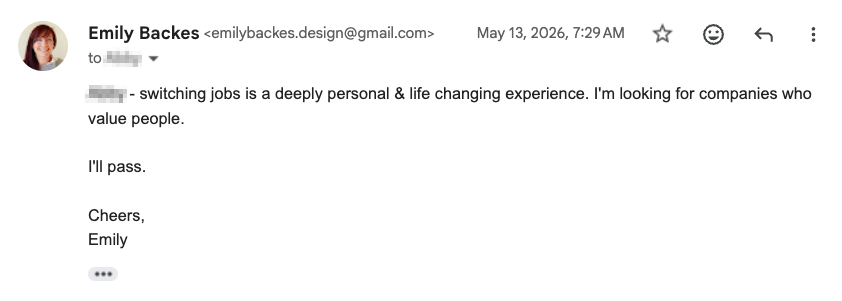
I ran that exact kind of screen for years as a technical recruiter, coordinating calendars and chasing interviewer feedback across multiple open requisitions at a time. I’ve spent the years since designing and shipping my own AI product, Sortly Sage, a chatbot that doubled its resolution rate and cut agent tickets 29% by its second iteration. I said once, in an earlier post about job search burnout, that I didn’t know if AI had made hiring any better or worse. I’ve been sitting with that question since, and this post is me actually answering it.
Here’s the answer: AI interviewers aren’t a weird one-off you might get unlucky enough to run into. They’re infrastructure now, built by companies with real incentives to use them, breaking in ways that are genuinely predictable if you’ve ever shipped a chatbot yourself, and landing candidates in lawsuits that are actually moving through federal court in 2026. None of that is theoretical. All of it is closer to your next interview than you’d think.
AI interviewers aren’t an edge case anymore
The video of Colin’s AI interview reads like a fluke because it’s the only version of this story that’s visual and shareable. The underlying numbers say otherwise. A 2026 Resume Now survey of over 900 US hiring professionals, reported by The Interview Guys, found that 96% now use AI somewhere in their recruiting process. A separate, corroborating industry aggregate puts 87% of companies using AI in at least one part of hiring. For video interviews alone, the number is 19.4% of companies, and it splits hard by size: roughly 60% of large employers use AI in HR versus 33 to 35% of small and midsize ones. Bigger company, higher applicant volume, more pressure to automate the first screen.
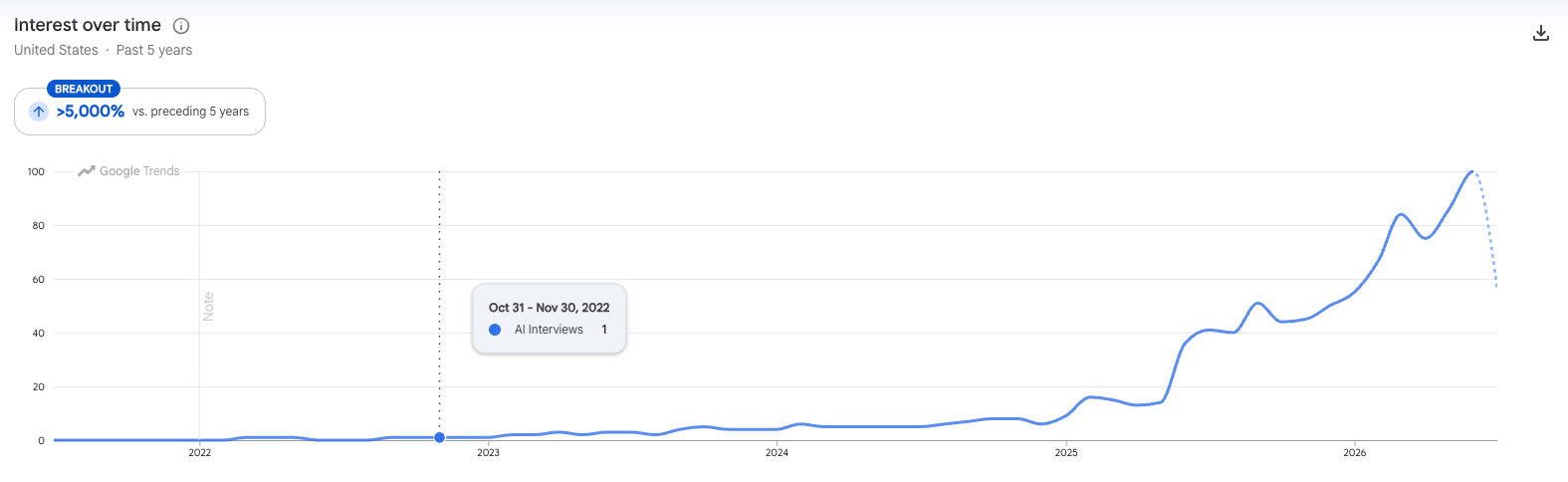
Public search behavior backs this up independently of any self-reported survey. Google Trends classifies “AI interviews” as a breakout term in the US, up more than 5,000% over the past five years, with the curve essentially flat through 2022 and 2023 before bending sharply upward through 2025 and into 2026. The phrase went from statistically nonexistent to mainstream in about two years, the same window the adoption numbers above cover. That’s a sudden jump, not a slow build.
So AI is nearly universal on the employer side. Candidates aren’t nearly as sold. Only 26% trust AI to evaluate them fairly, which is a genuinely wide gap against that 87% adoption figure. And here’s the part I think is the most honest finding in all of this: candidates don’t even agree with themselves. 66% of US adults say they wouldn’t apply to a job that uses AI in hiring at all. But a separately sourced figure claims 78% of candidates who were given an actual choice between an AI interviewer and a human recruiter picked the AI. Those two numbers aren’t reconcilable into one clean story, and I’m not going to pretend they are. The honest read is that people are conflicted, not settled. Told in the abstract, AI in hiring sounds bad. Given the actual choice, in the room, plenty of people would rather talk to a bot than sit through the awkwardness of a human screen.
Told in the abstract, AI in hiring sounds bad. Given the actual choice, in the room, plenty of people would rather talk to a bot than sit through the awkwardness of a human screen.
Both of those things are true about the same population, possibly the same person on different days.
A separate report from Greenhouse measures that same gap and finds it even wider. Across 4,136 respondents in the US, UK, Ireland, and Germany, surveyed in late 2025, 70% of hiring managers said AI helps them make faster, better decisions with fewer resources. Only 8% of job seekers called the resulting hiring practices fair. The same report found 41% of US job seekers admitted to using prompt injections to try to slip past AI filters, and 46% said they’d lost trust in the hiring process over the past year, 42% of them blaming AI directly. Greenhouse’s own CEO, Daniel Chait, called it an “AI doom loop”: candidates use AI to apply to more jobs, companies use AI to screen more of those applications back out, and neither side ends up better off. It’s the same gap as the 26%-trust figure above, this time measured by a company that sells hiring software for a living, and it’s worse.
Why companies actually run AI interviews
None of this is companies being careless. It’s companies doing cost and speed math at a volume most candidates never see from the outside.
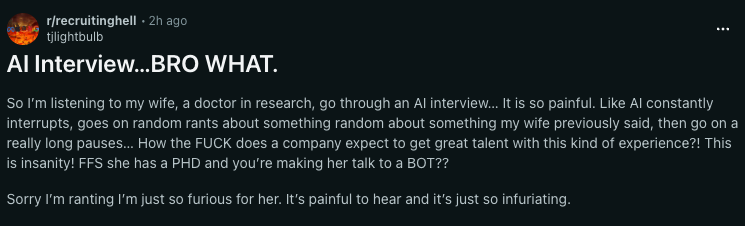
I managed multiple requisitions at any given time as a technical recruiter, and the bottleneck was never a shortage of qualified people. It was my own calendar. A first-round screen that takes fifteen minutes with a person takes fifteen minutes of a recruiter’s day, times however many candidates apply, times however many open reqs are stacked on top of each other. I wrote about how that math turns into six-round interview loops even after the candidate is hired. The same math is what pushes companies toward an AI for the very first screen, before a human ever gets involved. An AI agent can run that first fifteen-minute conversation with a thousand candidates at once, at 2 AM, without a recruiter’s calendar being the constraint. The size gap in the adoption data, large companies running higher application volume than small ones, is exactly the shape you’d expect if this were about throughput, not enthusiasm for the technology itself.
I’m not defending every implementation. I watched plenty of well-intentioned recruiting decisions get made for reasons that had nothing to do with the candidate on the other end of them, and I don’t think this is different. But it’s worth being precise about the actual incentive. Nobody built an AI interviewer because they wanted to replace the human connection of a screening call. They built it because the alternative was more recruiters, more hours, or more candidates falling through the cracks of a process that was already too slow.
Nobody built an AI interviewer because they wanted to replace the human connection of a screening call. They built it because the alternative was more recruiters, more hours, or more candidates falling through the cracks.
That’s a real tradeoff. It just doesn’t get made visible to the candidate on the other side of the screen, the one who has no idea if the tradeoff was made well.
The glitch isn’t mysterious. The legal exposure is real.
Here’s where I can say something most coverage of this topic can’t: I know exactly why an AI interviewer repeats itself and breaks down mid-conversation, because I’ve shipped the kind of product that does this when it’s built wrong.
Sortly Sage, the chatbot I designed, got rebuilt from a full-page destination into a collapsible drawer specifically because it kept failing at the edges of what it was scoped to handle. Conversational AI breaks in well-documented, boring ways: a container that was never designed to hold a certain kind of input, a model that loses its place in a long exchange, an escalation path to a human that either doesn’t exist or wasn’t built well enough to trigger. When Sage hit a question outside its scope, the failure mode mattered more than the failure itself. A bad handoff meant a customer explaining their whole problem over from scratch. A good one meant the conversation kept moving. An AI interviewer repeating “Vertical bar Pilates” on a loop is the exact same failure pattern: a system that hit an edge case its designers didn’t handle, with no escalation path that kicked in before it ended the interview outright. That’s an unfixed problem, not an unexplainable one, and those are very different things to be angry about.
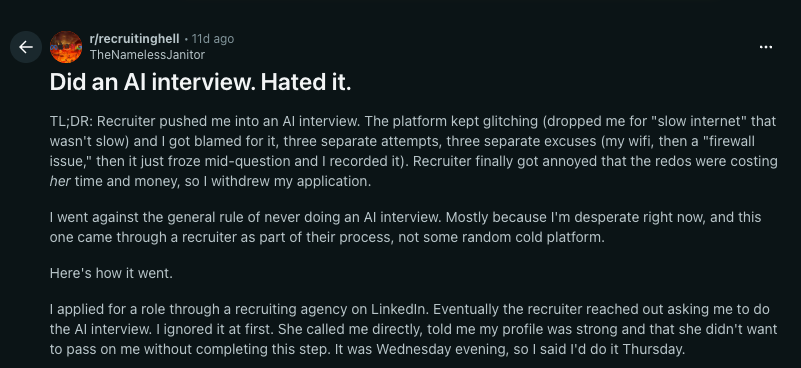
The stakes stop being a UX complaint the moment the system’s output decides who gets a job. Derek Mobley alleges he was rejected from over 100 positions that used Workday’s AI screening, some rejections arriving within minutes, too fast for any human to have looked at his application. A federal judge rejected Workday’s argument that it was merely a tool vendor, not an employer, and let discrimination claims in Mobley v. Workday proceed. A separate class action filed January 21, 2026, Kistler and Bhaumik v. Eightfold, alleges the platform secretly scored applicants with AI without their knowledge or consent, in violation of the Fair Credit Reporting Act. One Workology piece put it about as plainly as it can be put: the same company had been asked about bias in its AI back in 2020, and got sued over exactly that in 2026.
Regulators are moving too, not just plaintiffs’ lawyers. The EU AI Act classifies hiring AI as “high-risk,” and full enforcement begins August 2, 2026, with fines up to €15 million or 3% of global turnover for noncompliance. That date lands a little over a week after this post goes up. This isn’t a distant hypothetical getting written about early. It’s a countdown.
Reflective Coda
None of this means you should refuse an interview the moment you suspect an AI is on the other end of it. What it means is that “will I be speaking with a person or an AI system?” is now a completely reasonable question to ask before you accept the invite, the same way “how many rounds should I expect” is a reasonable question about any loop. HireVue is the platform you’re most likely to actually run into, and asking upfront isn’t paranoid. It’s the same instinct that should make you ask about round count, or ghosting policy, or anything else about a process you’re about to hand hours of your life to.
What you’re really listening for isn’t whether AI is involved. Nearly everyone’s process involves it somewhere now. You’re listening for whether the company can tell you clearly what happens when the AI hits something it can’t handle. A team that’s thought that through will tell you there’s a person who reviews flagged cases, or that the tool only screens for one narrow thing before a human takes over. A team that hasn’t thought it through will get vague, or won’t have considered the question at all.
You’re listening for whether the company can tell you clearly what happens when the AI hits something it can’t handle. That gap, not the AI itself, is the actual signal.
Kendiana Colin’s interview didn’t end because Apriora’s AI was evil or even particularly broken by industry standards. It ended because nobody had built the part of the system that catches a conversation before it spirals, the same unglamorous engineering work that separates a chatbot people trust from one that goes viral for the worst reason. Ask the question before you’re the one stuck on a call listening to a bot repeat itself back at you. It’s a smaller ask than it sounds like, and it’s the one question in this whole process that’s entirely within your control.
Sources
- Deranged Video Shows AI Job Recruiter Absolutely Losing It During an Interview (Futurism)
- AI Job Interview Spirals Into ‘Dystopian’ Loop (AOL)
- Deranged Video Shows AI Job Recruiter (Yahoo Tech)
- How AI Is Being Used in Job Interviews (TIME)
- The State of AI in Job Interviews 2026: The Year 96% of Hiring Pros… (The Interview Guys)
- An AI Trust Crisis: 70% of Hiring Managers Trust AI to Make Faster and Better Hiring Decisions, Only 8% of Job Seekers Call It Fair (Greenhouse)
- I Interviewed Eightfold AI About Bias in 2020. Then They Got Sued in 2026. (Workology)
- Workday AI Bias Lawsuit: Why Millions Were Rejected by Algorithms (AllAboutLawyer)
- Eightfold Lawsuit (Lawfold)
- Emily Backes, “How I Doubled Chatbot Resolution Rate and Cut Agent Tickets 29% by Turning Sortly Sage from a Full Page into a Sidekick”, 2026.